
 |
Written by Liz McDermott |

CSHM certification and CSMP certification are two credentials that stand out in the safety management field, but they take different paths to get you there. CSHM leans toward education and formal training, while CSMP values hands-on experience and practical knowledge. Let's walk through what makes each one unique.

TABLE OF CONTENTS:
- What Are CSHM and CSMP Safety Certifications?
- Eligibility Requirements: Which IHMM Safety Certification Can You Qualify For?
- CSMP and CSHM Certification Exam Format and What to Expect
- Career Impact and Salary Benefits
- How to Choose Between CSHM and CSMP Certification
- Conclusion
What Are CSHM and CSMP Safety Certifications?
CSHM: Certified Safety and Health Manager
CSHM stands for Certified Safety and Health Manager. This credential targets safety professionals who combine formal education with practical work experience. The certification signals to employers that you've mastered both academic safety principles and real-world application. CSHM holders typically hold degrees in occupational safety, environmental health, or related fields, then build their careers from that educational foundation.
The CSHM certification carries weight with organizations looking for safety managers who can blend regulatory knowledge with strategic planning. In essence, CSHM certified positions you as someone who understands the theory behind safety protocols and can apply that knowledge to manage programs at scale.
CSMP: Certified Safety Management Practitioner
CSMP stands for Certified Safety Management Practitioner. This certification was designed for professionals who built their safety careers through hands-on experience rather than formal degrees. CSMP recognizes that many skilled safety practitioners learned their craft on the job, working through incident investigations, compliance audits, and employee training programs.
The CSMP certification credential validates experience-based expertise. Contrarily to CSHM's academic focus, CSMP opens doors for professionals who may have started in trades, operations, or field positions before moving into safety roles. Employers recognize CSMP holders as practitioners who understand workplace hazards from ground-level experience.
Key Differences Between the CSHM and CSMP Certification Credentials
The fundamental split between these occupational safety certifications comes down to your career pathway. CSHM requires a formal degree as part of its eligibility criteria. You need either a safety-related bachelor's degree or a general bachelor's degree, paired with corresponding years of experience. CSMP, on the other hand, accepts high school diplomas or GED certificates as the educational baseline.
CSHM certification candidates with safety-related bachelor's degrees need four years of experience, while those with general bachelor's degrees need five years. CSMP certification candidates with only a high school diploma must demonstrate three years of full-time safety experience. For those working in roles where safety comprises 25–50% of their duties, CSMP offers partial credit at a rate of two years worked per one year of experience credit.
Both paths eventually lead to similar career opportunities, but they reflect different professional journeys. CSHM certification fits professionals who pursued safety as a planned career from college onward. CSMP certification serves those who discovered their safety expertise through years of practical work.
Who Awards These CSHM and CSMP Certifications?
The Institute for Hazardous Materials Management (IHMM) awards both CSHM and CSMP certifications. IHMM operates as an independent credentialing body focused on environmental health and safety professions. The organization maintains exam standards, blueprints, and continuing education requirements for credential holders.
Major employers recognize both credentials. Organizations like Amazon, ExxonMobil, Boeing, the U.S. Navy, OSHA, GM, and Honeywell hire safety professionals with CSHM and CSMP certifications. This broad recognition across manufacturing, government, defense, and private sectors demonstrates that both certifications carry professional credibility regardless of which pathway you choose.
Eligibility Requirements: Which IHMM Safety Certification Can You Qualify For?
Understanding which occupational safety certifications you qualify for starts with examining your educational background and work history. Both CSHM certification and CSMP certification offer multiple entry routes, but they reward different combinations of schooling and experience.
CSHM Education and Experience Requirements
CSHM offers four distinct qualification pathways, each balancing formal education with professional experience. If you hold a safety-related bachelor's degree in fields like occupational safety, environmental health, or industrial hygiene, you need four years of relevant work experience. Professionals with bachelor's degrees in unrelated fields qualify after five years of safety management experience.
Associate degree holders face a steeper climb. Specifically, those with safety-related associate degrees must accumulate six years of experience before applying. This extended timeline reflects CSHM's emphasis on formal education as a foundation, requiring additional practical work to compensate for shorter academic programs.
The financial commitment remains consistent across all pathways. Candidates pay $175 for the application process and $360 for the exam itself, totaling $535 for the complete certification attempt.
CSMP Education and Experience Requirements
CSMP takes a fundamentally different approach by prioritizing field experience. The baseline pathway requires only a high school diploma or GED certificate paired with three years of full-time safety management work. This route opens doors for professionals who built expertise through hands-on learning rather than classroom instruction.
Professionals holding safety-related associate degrees can fast-track their qualification. Given that these candidates already completed technical training, CSMP certification requires just one year of professional experience before they can sit for the exam. This accelerated pathway acknowledges that associate programs in safety provide practical skills that translate directly to workplace application.
Application and exam fees mirror CSHM's structure at $175 and $360 respectively, keeping costs identical between both credentials.
The ASHM Pathway Option
ASHM (Associate Safety and Health Manager) serves as an alternative entry point for CSHM qualification. Professionals who earn the ASHM credential first can apply for CSHM after logging two additional years of safety management experience. In other words, ASHM functions as a stepping stone that allows you to start credentialing earlier in your career, then upgrade as you accumulate more professional practice.
The ASHM credential pathway particularly benefits mid-career professionals who meet some but not all traditional CSHM requirements. The two-year experience requirement after ASHM certification provides a structured progression timeline.
Safety Experience Credit Guidelines for CSMP Certification
Not all safety roles carry equal weight in qualification calculations. CSMP acknowledges that many professionals handle safety responsibilities as part of broader job functions rather than dedicated positions. For roles where safety duties comprise 25–50% of total responsibilities, CSMP grants partial credit at a specific ratio: two years of actual work time equals one year of qualifying experience credit.
For instance, if you spent four years in a position where safety tasks represented 40% of your duties, CSMP would credit you with two years of qualifying experience. This calculation method ensures the credential values concentrated safety practice while still recognizing mixed-function roles common in smaller organizations or emerging safety programs.
Furthermore, both credentials require experience in genuine management functions, not just technical tasks. Your work history should demonstrate program oversight, policy development, compliance auditing, or team supervision to meet eligibility standards.
CSMP and CSHM Certification Exam Format and What to Expect
Both CSHM certification and CSMP certification use the same rigorous testing approach, though understanding the exam format helps you prepare strategically. IHMM designs both assessments around detailed blueprints that outline competency domains and knowledge areas.
IHMM Exam Structure and Duration
IHMM structures both exams as proctored assessments, meaning you'll take them under supervised conditions rather than open-book formats. The exams follow standardized blueprints published by IHMM, which you can download directly from their website. These blueprints break down the percentage weight of each knowledge domain, helping you allocate study time proportionally.
Since both occupational safety certifications share similar professional standards, the exam formats maintain comparable rigor. IHMM does not publish a single required textbook for either exam. Instead, the blueprints serve as your primary study guide, outlining what you need to know without prescribing specific learning materials.
CSHM and CSMP Exam Prep Courses
In partnership with IHMM, Vubiz offers online exam prep courses to help certification candidates study at their own pace:
|
Topics Covered on CSHM and CSMP Certification Exams
Both exams test your knowledge of OSHA regulations, hazard analysis methodologies, safety audit procedures, labor law compliance, workers' compensation systems, and business management principles. This combination ensures certified professionals understand both technical safety requirements and the business context in which safety programs operate.
OSHA regulations form a substantial portion of the exam content, reflecting their role in workplace safety enforcement. You'll need to demonstrate familiarity with standards, inspection procedures, and citation processes. Hazard analysis questions test your ability to identify risks, assess severity and probability, and recommend control measures using established frameworks.
Safety audits and program evaluation represent another critical domain. These questions assess whether you can review existing safety systems, identify gaps, and propose improvements. Labor law coverage extends beyond OSHA to include employment regulations that intersect with safety management, such as reasonable accommodation requirements and workplace injury reporting obligations.
Workers' compensation knowledge proves necessary since safety managers frequently interact with claims processes, return-to-work programs, and experience modification calculations. Business principles round out the exam by testing your understanding of budgeting, ROI analysis, and organizational change management as they apply to safety initiatives.
CSMP and CSHM Passing Scores and Retake Policies
IHMM maintains specific passing standards for both CSMP and CSHM certifications, though these details require verification directly with the organization for the most current requirements. The blueprints provide scoring domain weights, but candidates should confirm exact passing thresholds and retake procedures during the application process. Preparation courses often include practice exams that mirror the blueprint's domain distribution, giving you a realistic preview of question types and difficulty levels.
Remote vs. In-Person Testing Options
Both exams offer flexible delivery through Kryterion, a proctoring platform that supports in-person and remote testing. Remote proctoring became standard practice across professional certifications, allowing candidates to test from home or office locations under monitored conditions. The platform uses webcam supervision and screen monitoring to maintain exam integrity.
In-person testing remains available at designated testing centers for candidates who prefer traditional environments. Either option delivers the same exam content and carries identical weight on your credentials. Your choice depends purely on personal preference and logistical convenience. Remote testing eliminates travel requirements, while in-person centers provide dedicated testing environments free from home distractions.
Preparation courses and blueprint study remain your most reliable tools regardless of which testing format you select. IHMM recommends either structured exam prep courses or disciplined self-study using the published blueprints as your roadmap through the material.
Career Impact and Salary Benefits
Earning either credential translates directly into measurable career gains and financial returns. The data shows clear patterns in how these occupational safety certifications affect professional trajectories and compensation packages.
Average Salary Increase After CSMP / CSHM Certification
Certified professionals command higher salaries than their non-certified counterparts. IHMM salary data reveals that certified safety managers earn a median of $100,000 annually, compared to $83,000 for non-certified peers — representing a 20% salary premium. This $17,000 difference compounds over a career, making the $535 certification investment recover itself within months.
"75% of IHMM credential holders reported
earning more money after certification." (IHMM)
The increase varies based on job title and geographic location. EHS Managers, Safety Directors, and Compliance Officers see the most pronounced salary jumps. Professionals often recoup their certification costs through their first post-credential raise.
Job Opportunities and Career Advancement
Career progression accelerates after earning CSHM certification or CSMP certification. Specifically, 88% of certified professionals experienced career advancement following their credential achievement. This advancement takes multiple forms: promotions to director-level positions, transitions from technical roles into management, or lateral moves into higher-paying organizations.
The credentials function as qualifiers for positions that list certification as required or preferred in job postings. Many organizations won't consider candidates for senior safety roles without recognized credentials, making certification a gateway rather than just an enhancement.
Industries That Value These Credentials
Major employers across sectors actively recruit certified safety professionals. Amazon, ExxonMobil, and Boeing rely on CSHM and CSMP holders to manage their expansive safety programs. Government agencies including the U.S. Navy and OSHA hire certified professionals for regulatory and compliance positions. Manufacturing giants like GM and Honeywell prioritize these credentials when building their environmental health and safety teams.
The breadth of industries spans manufacturing, energy, aerospace, defense, government regulation, and commercial logistics. This diversity means your certification opens doors across economic sectors rather than limiting you to niche markets.
Real Professional Success Stories
John Poole, CSHM, represents one success trajectory these credentials enable. His certification facilitated movement into strategic safety leadership roles where he shapes organizational safety culture rather than just implementing programs. Daniel Blankfeld pursued both CSHM and CSMP credentials, positioning himself for consulting opportunities that require demonstrated expertise across multiple certification frameworks. His dual credentials signal comprehensive knowledge that appeals to clients seeking versatile safety expertise.
These professionals illustrate how certification creates tangible career options that remain unavailable to non-certified practitioners regardless of experience level.
How to Choose Between CSHM and CSMP Certification
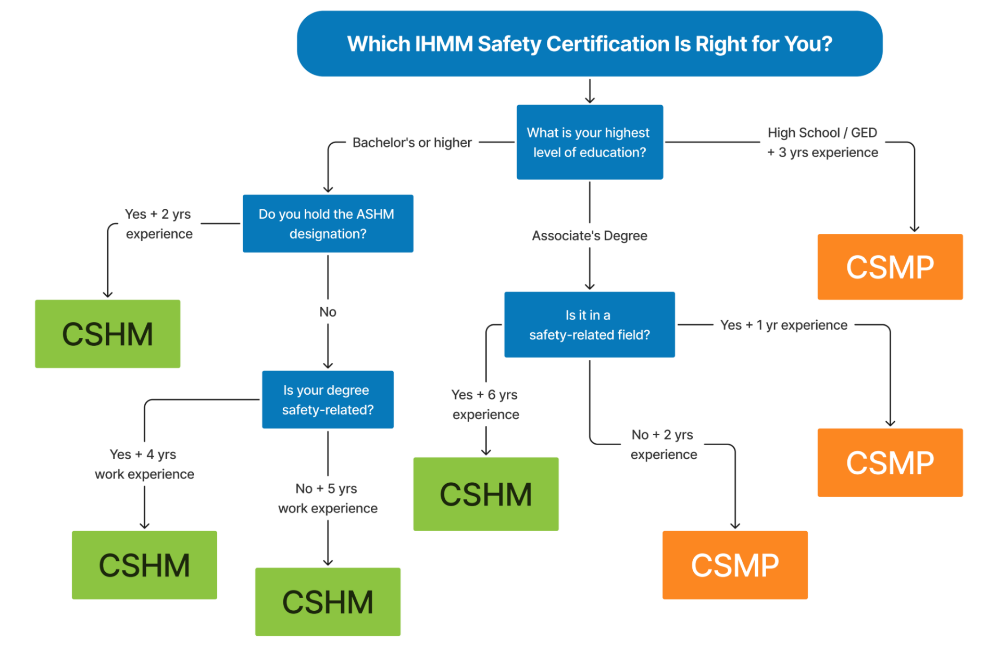
Your educational background determines which path fits your profile. The choice between these occupational safety certifications hinges on credentials you already hold rather than career goals, since both lead to similar outcomes.
If You Have a Degree: CSHM Certification Path
Bachelor's degree holders should pursue CSHM certification. The pathway aligns with how you built your career foundation. Safety-related degrees require four years of experience, while general degrees need five. This structure rewards formal education by shortening the experience requirement compared to CSMP's baseline.
Associate degree holders with safety-related programs also qualify for CSHM after six years of work. The credential validates your academic training and positions you alongside four-year degree holders in the job market. Employers recognize CSHM as the standard for professionals who followed traditional educational routes into safety management.
If You're Experience-Heavy: CSMP Certification Path
Professionals without bachelor's degrees should pursue CSMP certification. The credential was built for this exact scenario. Three years of full-time safety experience with a high school diploma qualifies you immediately. Consequently, you can certify without returning to school for a degree you may not need.
Those with safety-related associate degrees fast-track through CSMP with just one year of experience. The pathway acknowledges your technical training while prioritizing field practice. CSMP removes educational barriers that might otherwise block experienced practitioners from professional recognition.
Cost Comparison and ROI Timeline
Both credentials cost identical amounts: $175 for application processing plus $360 for the exam. Your total investment reaches $535 regardless of which certification you choose. The ROI timeline remains equally consistent, with most professionals recovering costs within their first raise or job change after certification.
Making Your Final Decision
Match your qualification to your background. Degree holders fit CSHM's structure. Experience-focused professionals fit CSMP's design. The certifications carry equal weight with employers, so choose based on which eligibility requirements you already meet rather than perceived prestige differences that don't exist in practice.
Conclusion
The CSHM vs. CSMP decision doesn't need to be complicated. Both occupational safety certifications deliver identical career benefits, salary increases, and employer recognition. The determining factor is simple: your educational background.
Hold a bachelor's degree? CSHM is your match. Built your career through hands-on experience? CSMP was designed for you. Either way, both credentials cost $535 and deliver that same 20% salary premium.
Your existing qualifications point you toward the right path. Choose the certification that aligns with credentials you already have rather than overthinking which sounds more impressive. Either way, you're investing in a credential that employers across industries actively seek.